
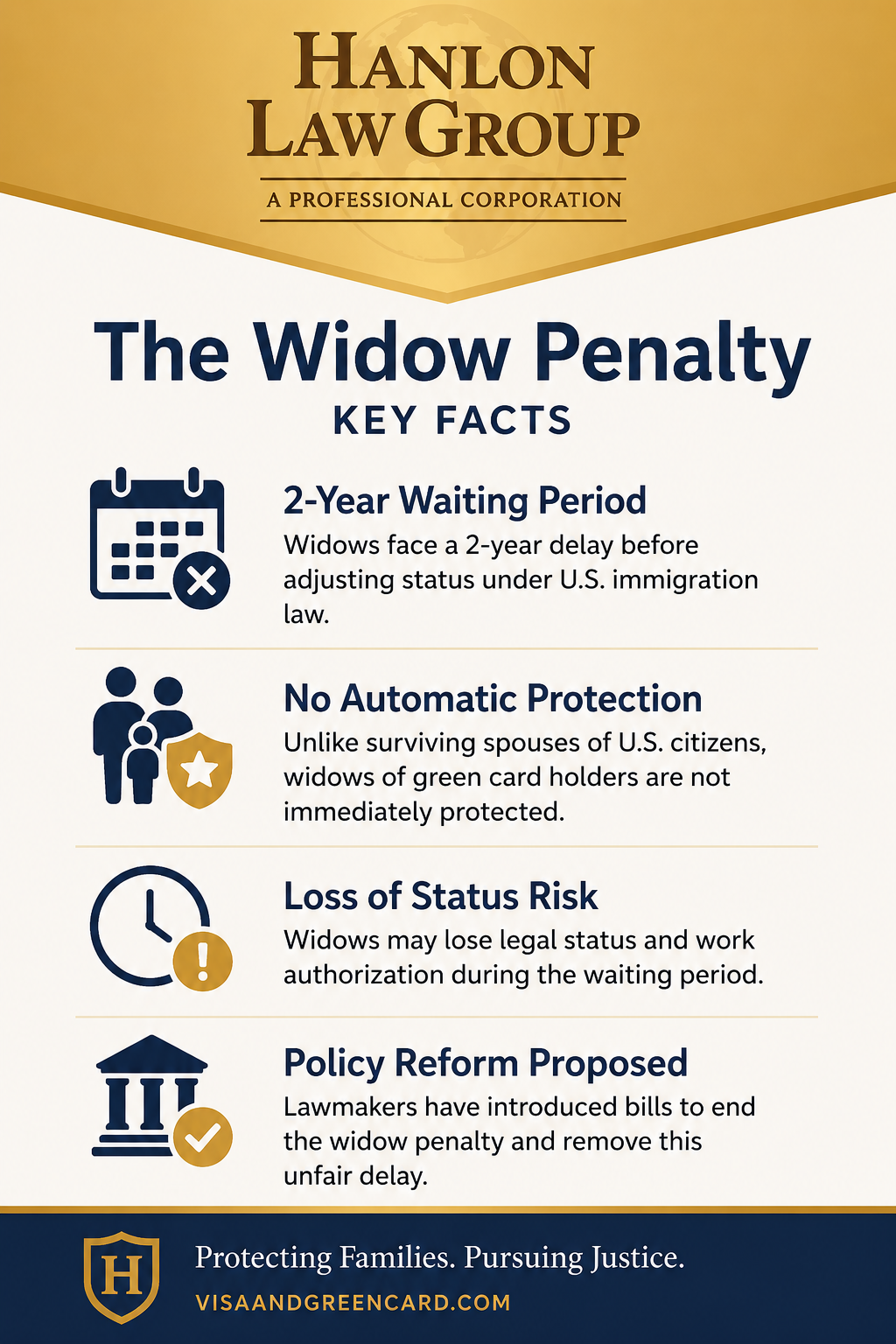
Previously, the “widow penalty” law mandated that a foreign national married to a U.S. citizen would face deportation if their spouse passed away before their two-year anniversary. Before 2009, countless individuals, regardless of the length of their relationship, their profession, or whether they had children, were forced to leave the U.S. after the death of their spouse. This created significant challenges for families who had begun building their lives in the U.S. and suddenly found themselves at risk of deportation during a time of loss. However, with the introduction of the new law in 2009, the situation improved for many. Now, widows or widowers of U.S. citizens can apply for a green card, even if their spouse passes away before the two-year mark. This provision also extends to their children born outside the U.S., allowing them to remain together as a family. In certain cases, the law may provide relief for other surviving relatives, ensuring that family immigration continues despite the tragedy of losing a loved one.
This change has offered more stability and protection for grieving families navigating the immigration system. Additional protections for families have come through the Child Status Protection Act, which helps children maintain their eligibility for immigration benefits even if they age out during the application process. Programs like Deferred Action for Childhood Arrivals (DACA) further underscore the U.S. immigration system's evolving focus on keeping families together, offering relief to individuals who arrived as children and may otherwise be separated from their families. Together, these laws and programs highlight the growing importance of family unity in U.S. immigration policy. If you wish to learn more about the widow penalty in immigration and explore your legal options for staying in the U.S., contact a Los Angeles attorney from Hanlon Law Group, PC.
Related: Can a Green Card Holder Be Deported?

The attorney at our firm can guide you in determining the most suitable route for staying in the U.S. after the unfortunate demise of your spouse. We can assist you in applying for a green card for yourself and any children born outside the U.S. Our expertise lies in guiding clients through the green card application process, ensuring a comprehensive and prompt application.
For detailed insights about the widow penalty in immigration or procuring a K-3 or green card as the spouse of a U.S. citizen, reach out to our Los Angeles immigration law firm. We offer a complimentary initial consultation to address your immigration-related queries. For immediate assistance, call us at 866-227-5527.
Reviewed for legal accuracy by Daniel P. Hanlon on October 05, 2026
No—as long as the marriage had reached or surpassed the two-year mark at the time of the spouse’s death, the widow penalty is not applicable. That means the surviving spouse can proceed with the green card process through Form I-360 regardless of the death’s timing. Evidence such as the marriage certificate and spouse’s date of death is required to confirm the timeline. It’s vital to document these accurately to assure USCIS of eligibility. Consulting an immigration attorney can help ensure all relevant evidence is properly submitted. Meeting the two-year requirement at any point before or at the time of death generally safeguards eligibility. At Hanlon Law Group, P.C., we can help you navigate the legal process and pursue a green card based on your circumstances. For better assistance, reach out to us.
The trusted Los Angeles immigration attorney at Hanlon Law Group, P.C. is waiting to speak to you, find out more about your immigration needs, and explain your options. Having handled countless professional visa applications for foreign professionals and U.S. employers, our lawyer has the experience and insight you can count on for exceptional service and representation.
Our experience, skills and dedication to our clients are backed by the following, which all of our clients can expect to receive:


